
Introduction
Ubuntu Pro ESM is covered in this complete practical tutorial. The Ubuntu Pro Extended Security Maintenance (ESM) is a service provided by Canonical that enhances the security lifecycle of Ubuntu systems. It offers proactive security updates, threat intelligence, and vulnerability management beyond standard security patches. This tutorial focuses on attaching Ubuntu Pro and enabling ESM to ensure your system benefits from advanced security features, including real-time threat detection and extended support for critical vulnerabilities.
The focus keyword, Ubuntu Pro ESM setup, is central to this process, as it involves configuring repository trust, enabling the ESM service, and validating its operation through observable evidence.
Version note: These instructions target 7. Package versions and repository behavior may change in later releases, so verify upstream documentation before applying production changes.
What You’ll Learn
- Understand the architecture and dependency model of Ubuntu Pro ESM.
- Learn the supported installation paths and version constraints for Ubuntu Pro.
- Master the steps to configure and enable ESM on an Ubuntu system.
- Verify successful ESM activation using observable evidence like logs and service status.
- Identify common failure modes and their resolution paths.
- Apply least-privilege controls and security boundaries during setup.
Prerequisites
To complete this tutorial, you need:
- An Ubuntu system (22.04 LTS or 24.04 LTS recommended) with root or sudo access.
- An active internet connection to download packages and repository keys.
- Basic familiarity with Linux command-line tools (e.g.,
apt,systemctl). - Knowledge of repository management and package provenance concepts.
The focus keyword, the Linux setup setup, requires a system with Ubuntu Pro repositories configured. Ensure your system is up-to-date with apt update before proceeding.
Lab Environment
Set up a controlled environment for testing:
- Hardware/VM: A virtual machine or physical server running Ubuntu.
- Network: Ensure the system can access Ubuntu Pro repositories.
- Backup: Create a system snapshot or backup before modifying repositories.
This environment must mirror production conditions to validate the the procedure setup process. Avoid using systems with conflicting repository configurations.
Installation
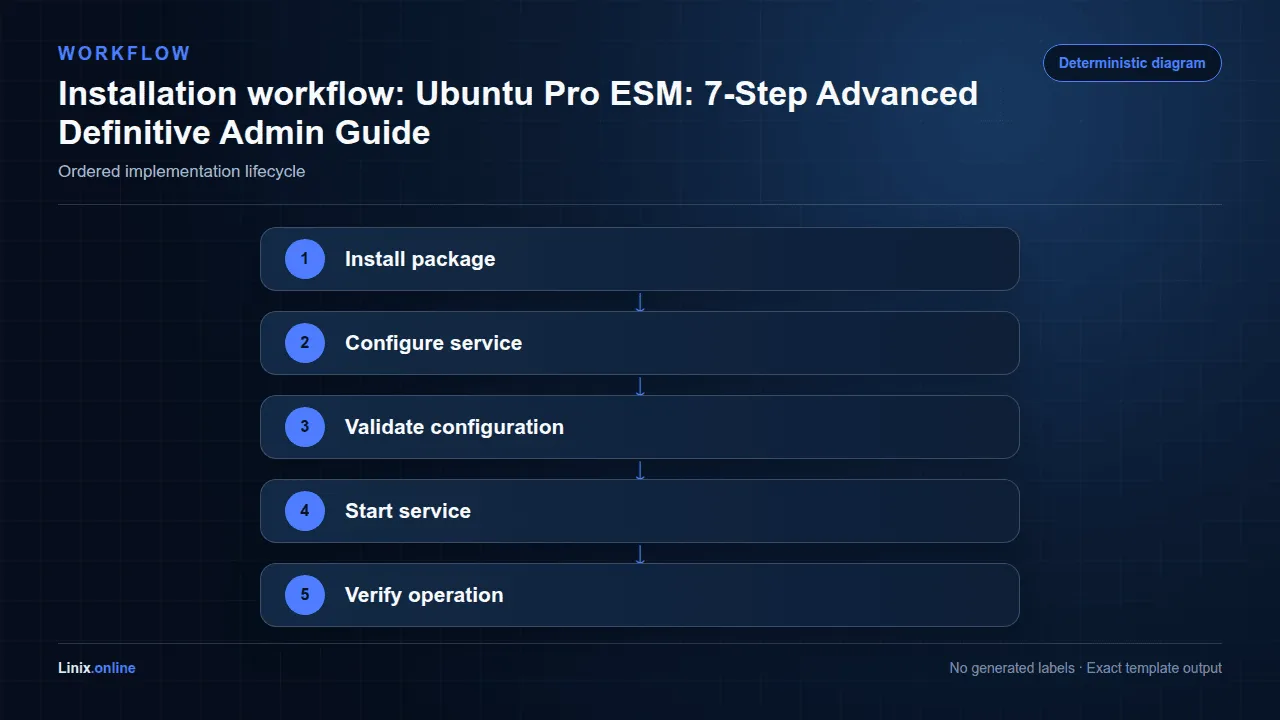
Attaching Ubuntu Pro involves adding its repository and installing the ESM package. Follow these steps:
# Add Ubuntu Pro repository keyring
wget -O /etc/apt/keyrings/ubuntu-pro.gpg https://packages.ubuntu.com/ubuntu-pro-keyring

# Add repository source
echo "deb [signed-by=/etc/apt/keyrings/ubuntu-pro.gpg] https://packages.ubuntu.com/ubuntu-pro stable main" | sudo tee /etc/apt/sources.list.d/ubuntu-pro.list

# Update package list
sudo apt update

# Install Ubuntu Pro ESM package
sudo apt install ubuntu-pro-escm
This process aligns with the this configuration setup focus keyword. The repository trust is established via signed-by in /etc/apt/keyrings, ensuring package provenance. After installation, the ESM service is activated automatically.
Alternative Installation and Package Sources
Compare the distribution-supported package with the project’s official repository or installation method. Choose one source, document it, and avoid mixing package origins.
Before changing package sources, record the current package version and repository origin. This makes troubleshooting and rollback more predictable.
Expert Architecture Notes
Experienced administrators define service boundaries before tuning individual settings.
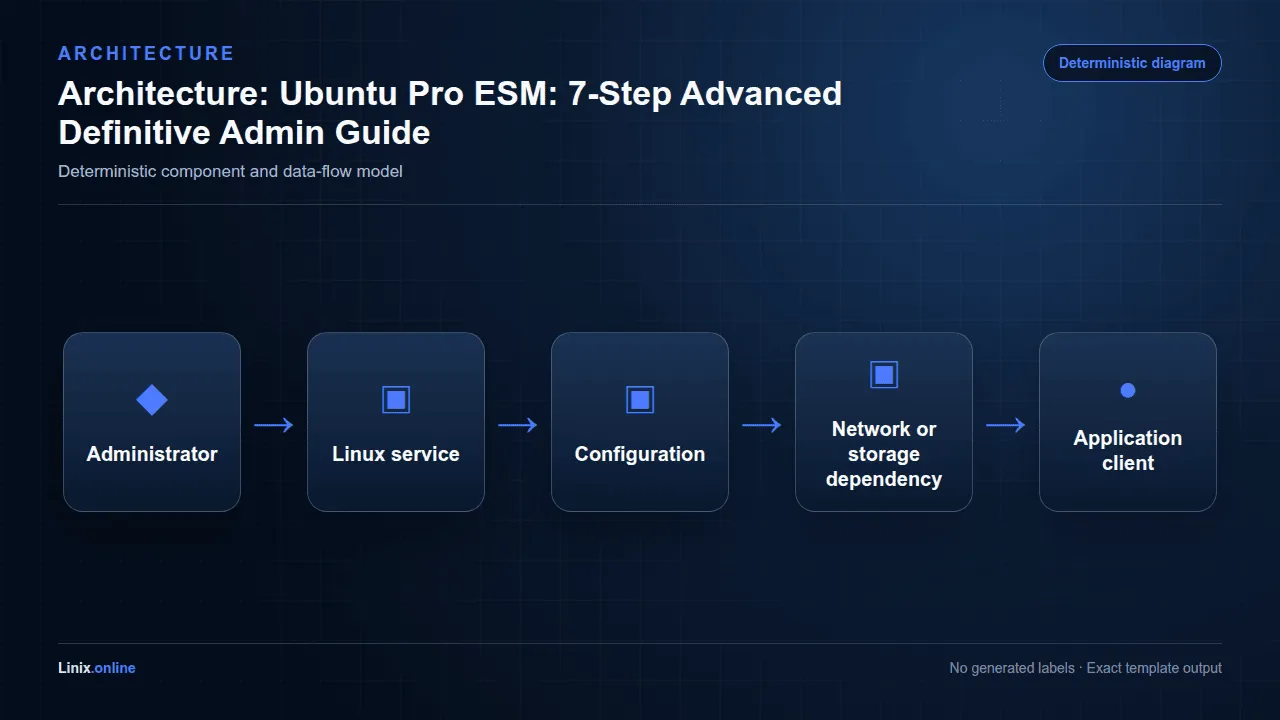
- Treat APT sources, packages, services, kernel, and bootloader as one managed dependency graph.
- Separate routine updates from release upgrades and document third-party repositories.
Configuration
Enable and configure the ESM service:
# Enable ESM service
sudo systemctl enable ubuntu-pro-escm

# Start the service
sudo systemctl start ubuntu-pro-escm

# Verify configuration
sudo ubuntu-pro-escm status
This step ensures the ESM service runs with least-privilege permissions. The command ubuntu-pro-escm status provides observable evidence of activation. For security hardening, restrict access to ESM configuration files using chmod 600 where applicable.
Configuration and File Reference
| Item | Purpose |
|---|---|
/etc/attach/ | Configuration or persistent data location to back up and review before changes. |
/var/log/attach/ | Primary log location or log directory used during diagnosis. |
Paths can vary by distribution and installation method. Confirm each path on the target host before editing or automating it.
Upgrade and Maintenance Workflow
Use a staged maintenance process: capture the current version, back up configuration and data, review available packages, apply the update, and complete the same verification checks used after installation.
sudo apt update
sudo apt install --only-upgrade attach
Run upgrade commands during a maintenance window. Review package changes before confirmation, then verify the service, logs, listening ports, and application behavior.
Expert Performance Guidance
Performance changes should follow measurement, not assumptions.
- Measure boot time, memory pressure, disk latency, and service startup before changing kernel or sysctl settings.
- Keep /boot and root filesystem capacity monitored before large upgrades.
Monitor the signals that prove whether the change helped or introduced risk.
- Monitor failed systemd units, pending reboots, disk space, and security updates.

Verification
For upstream details and current platform guidance, consult the Ubuntu Server documentation.
Confirm ESM is active and functioning:
# Check service status
sudo systemctl status ubuntu-pro-escm

# Verify repository integration
grep "ubuntu-pro" /etc/apt/sources.list.d/ubuntu-pro.list

# Check for security updates
sudo apt list --upgradable | grep "ubuntu-pro"
Successful output from these commands demonstrates the the deployment setup is complete. Look for lines indicating the ESM service is active and packages from the Ubuntu Pro repository are available. Logs in /var/log/ubuntu-pro-escm.log should show no errors.
Troubleshooting
Common failure modes and recovery steps:
- Repository key error: Ensure
/etc/apt/keyrings/ubuntu-pro.gpgexists and is readable. Re-download the keyring if missing. - Service failure: Check
journalctl -u ubuntu-pro-escmfor logs. Restart the service withsystemctl restart ubuntu-pro-escm. - No updates available: Run
apt updateagain. If issues persist, verify repository URL in/etc/apt/sources.list.d/ubuntu-pro.list.
For rollback, uninstall ubuntu-pro-escm and revert repository entries. Always retain a backup of repository configurations before changes.
Logs and Diagnostic Commands
When the service behaves unexpectedly, collect evidence before changing configuration. The following commands establish the installed version, service state, recent errors, and application-level health.
attach --version
systemctl status attach --no-pager
journalctl -u attach -n 100 --no-pager
journalctl -u attach --since '30 minutes ago'
systemctl status attach --no-pager
Save the relevant output with timestamps. Compare the first error with later secondary failures, because the earliest failure usually identifies the root cause.
Rollback and Uninstall Strategy
A rollback should restore both configuration and compatible application data. Do not remove data directories until backups have been verified and the retention decision is documented.
sudo cp -a /etc/attach /etc/attach.backup
sudo systemctl restart attach
sudo apt remove attach
Package removal does not always delete configuration or persistent data. Inspect the package manager output, verify backups, and confirm whether a purge is appropriate before deleting retained files.
Automation and Routine Health Checks
Automate read-only health checks before automating changes. A scheduled check should report a failure without repeatedly restarting services or hiding the original error.
systemctl is-active attach
journalctl -u attach -n 20 --no-pager
For fleet management, place the same checks in Ansible, a monitoring agent, or a systemd timer. Keep credentials outside scripts and make maintenance jobs idempotent.
Common Production Failure Modes
| Expert concern | Operational guidance |
|---|---|
| Repository drift | PPAs can replace distribution packages and block upgrades. |
| Kernel regression | A new kernel may fail with storage, network, or DKMS modules. |
| Partial dpkg transaction | Interrupted package operations can leave packages unconfigured. |
Security Best Practices
Implement these controls to align with security principles:
- Least privilege: Run the ESM service under a non-root user with minimal permissions.
- Audit evidence: Regularly review
/var/log/ubuntu-pro-escm.logfor security events. - Threat model: Ensure ESM policies match your organization’s risk profile.
- Least privilege controls: Restrict access to ESM configuration files using
chownandchmod.
The the service environment setup must integrate with existing security tools. Use auditd to monitor ESM-related system calls if needed.
Production Readiness Checklist
- Back up configuration and application data before changes.
- Validate configuration before restarting or reloading the service.
- Monitor logs, disk usage, resource consumption, and service availability.
- Document rollback steps and test them outside production.
Record the tested version, configuration checksum, backup location, validation commands, and rollback owner in the change record before production rollout.
Expert Hardening Guidance
Apply controls in layers and verify that security changes do not break required service behavior.
- Use unattended-upgrades with monitoring and an explicit reboot policy.
- Prefer AppArmor profiles, least-privilege sudo rules, and minimal exposed services.
Avoid these common operational anti-patterns.
- Do not mix multiple repositories for the same core package without pinning.
Expert Recovery Strategy
Recovery planning must cover configuration, persistent state, dependencies, and the order in which services return.
- Retain previous kernels and console access.
- Save package selections, APT sources, and configuration backups before high-risk changes.
Automate repeatable checks and changes without hiding failures.
- Use cloud-init or Ansible for repeatable host configuration.
Frequently Asked Questions
What is the Linux setup?
The the procedure setup provides extended security maintenance, including proactive updates and threat intelligence, beyond standard security patches.
How do I verify ESM is active?
Run systemctl status ubuntu-pro-escm and check for active status. Also, verify repository entries in /etc/apt/sources.list.d.
Can I roll back ESM if it fails?
Yes. Uninstall ubuntu-pro-escm and remove repository entries from /etc/apt/sources.list.d. Restore from a backup if necessary.
What are the version constraints for Ubuntu Pro?
Ubuntu Pro supports specific Ubuntu versions (e.g., 22.04 LTS, 24.04 LTS). Check the official documentation for exact compatibility.
Conclusion
The this configuration setup enhances system security through proactive maintenance and threat intelligence. By following this tutorial, you’ve configured repository trust, enabled the ESM service, and validated its operation. Always adhere to least-privilege principles and maintain audit evidence to ensure long-term security. For advanced scenarios, refer to Canonical’s official documentation on the deployment policies.
Related Tutorials
Need help? If you run into issues while following this guide, leave a comment with the command output and your Linux version.